
What Language Learning Apps Actually Do Well (And What They Don't)
Give credit where it is due. Apps are efficient at delivering comprehensible input — vocabulary, basic grammar patterns, reading, listening — in digestible quantities. This aligns neatly with what Stephen Krashen called the Input Hypothesis: the idea that language is acquired when learners receive input that is pitched just above their current level, which Krashen expressed as i+1. Apps can deliver i+1 at scale, at any time of day, without complaint. That is a genuine capability.
The problem is that Krashen's own model already contains the seeds of the app's limitation. Input, by definition, is what goes in. Fluency is what comes out. And the leap from one to the other is not automatic — it requires a separate mechanism that apps are structurally incapable of providing.
Merrill Swain identified this gap in her Output Hypothesis, developed through research on French immersion programmes in Canada during the 1980s and 1990s. Swain observed that learners who received substantial comprehensible input — years of it, in some cases — still struggled to produce accurate, fluent speech. Her argument was precise: the act of producing language forces learners to notice gaps in their knowledge that passive reception never surfaces. When you are selecting the correct answer from four options on a screen, you never discover that you cannot actually construct the sentence yourself. The gap in your knowledge remains invisible, because the task never required you to find it.
An app, in the end, is a reading and listening tool with a gamification layer. The gamification layer is clever. The learning ceiling is low.
Why Do Spoken Fluency and Vocabulary Knowledge Feel So Different?
Because they are different. This is not a philosophical distinction — it is a practical one with measurable consequences, and confusing the two is the reason so many competent app users find themselves paralysed in actual conversations.
Krashen's Monitor Hypothesis offers a useful explanation. Consciously learned rules — the kind that apps drill — can be used to self-edit, but only when the speaker has enough time to think. In a real conversation, there is no such luxury. A native speaker does not pause to allow you to run a mental grammar check before responding. The language needs to be internalised, not retrieved. And internalisation happens through production and interaction, not through pattern recognition on a screen.
Michael Long's Interaction Hypothesis, developed through the 1980s and refined substantially since, makes the mechanism even clearer. Long's argument is that negotiation of meaning — the back-and-forth of real conversation, particularly the moments of repair and clarification — drives second language development in ways that pre-packaged input simply cannot replicate. When a native speaker says "sorry, what did you mean?" and you have to rephrase, reorganise, and try again, that moment of communicative pressure is where acquisition happens.
A Duolingo exercise will teach you that sumimasen means excuse me. It will not prepare you for the speed at which a Japanese colleague delivers a correction, the cultural register that shifts depending on seniority, or the silence you are expected to observe before responding. The app teaches the word. A native-speaking instructor teaches the word in context, in use, with stakes attached.
Knowledge sits in your head. Usable speech comes out of your mouth. The training required to develop each is not the same.
Why Live Language Instruction Provides Something No App Can Replicate
Here is what the app lobby does not like to discuss: anxiety.
Krashen's Affective Filter Hypothesis proposes that psychological factors — anxiety, low confidence, poor motivation — create a kind of mental barrier that blocks acquisition even when input is present. A learner who is afraid of being wrong, or who is mortified by their accent, or who is simply convinced they are bad at languages, will not produce language freely. And production, as Swain demonstrated, is where fluency develops.
An app cannot lower the affective filter. It can offer a cheerful animation when you get an answer right, but it cannot read the room. It cannot tell whether you are genuinely acquiring the language or simply memorising the sequence of correct answers. It cannot sense that you are tense, or that you have just had a difficult day, or that you froze during a meeting this morning and have arrived at your lesson carrying the residue of that humiliation.
A skilled native-speaking instructor can do all of these things, and does.
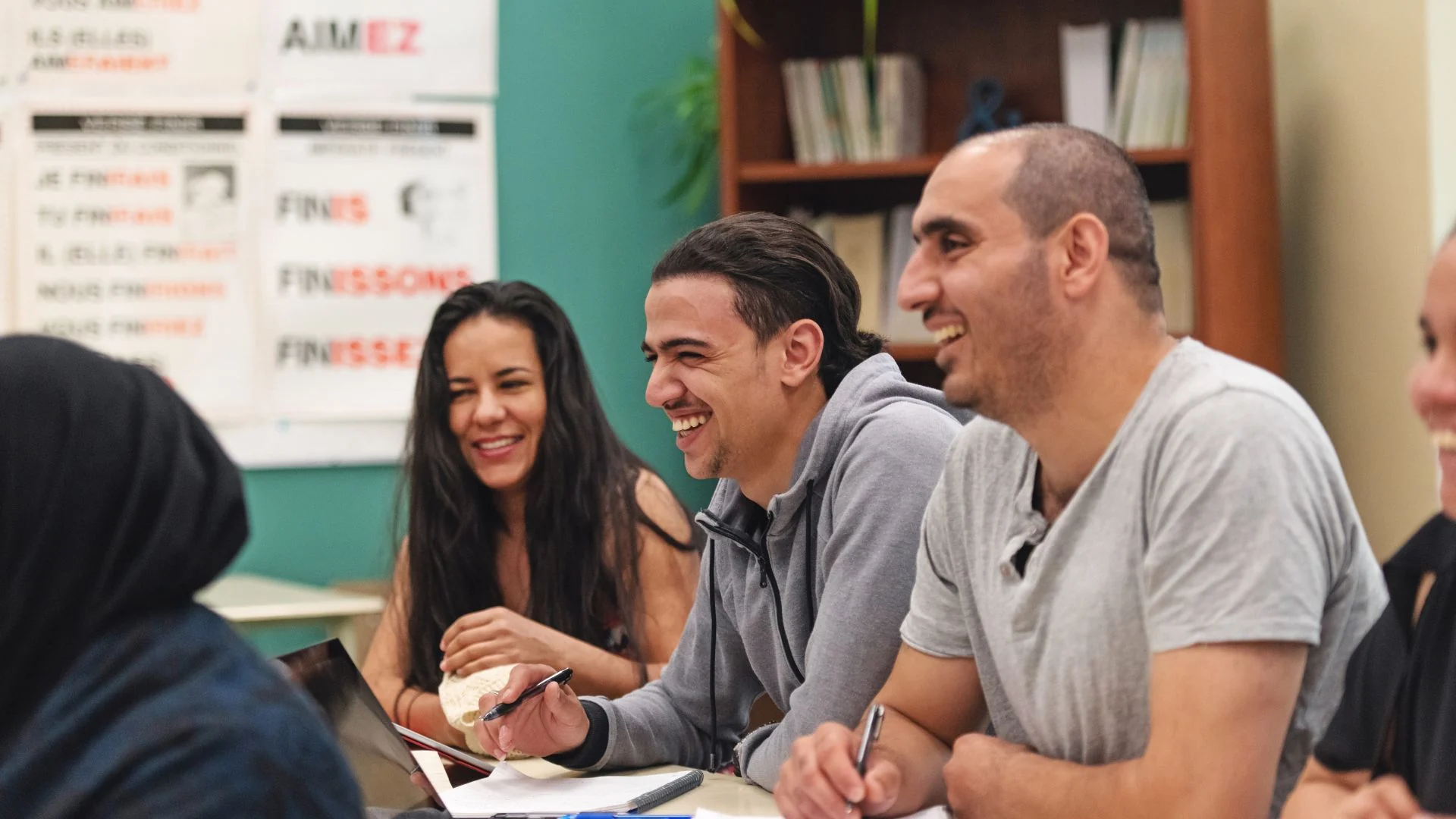
Consider what happens in a Lingua Learn Singapore business English session when a learner consistently confuses "I will" and "I am going to." The teacher — a native speaker matched specifically to the learner's level, objective and schedule — hears the pattern, stops, addresses the distinction in context, immediately constructs a scenario that makes the difference vivid, and then returns to the task. The correction is live, targeted, and embedded in a moment the learner will remember. No red X. No sound effect. No moving on to the next exercise as if nothing happened.
There is also a subtler form of knowledge that native speakers carry which no algorithm has yet managed to package: intonation, pragmatic politeness, the difference between directness and rudeness in a given professional culture, when silence is appropriate, what level of formality a given relationship demands. For professionals communicating across cultures — which describes the majority of Lingua Learn Singapore's learners — this is not an optional extra. It is often the thing that makes the difference between a successful meeting and a stressful one.
“Conversation is the laboratory and workshop of the student.Ralph Waldo Emerson
What Professionals Actually Need: Performance Under Pressure, Not Theoretical Knowledge
The gap between textbook grammar and operational fluency is one of the best-documented phenomena in applied linguistics. Communicative Language Teaching — CLT — emerged as a research-based response to exactly this problem: the observation that learners who could pass written grammar tests were functionally mute in real interactions. CLT is built on the insight that language is acquired most effectively through meaningful interaction, with the focus on communication rather than form.
A professional does not need to pass a grammar test. They need to chair a meeting in Mandarin, negotiate a contract in French, brief a team in Japanese, or explain a technical process to a Vietnamese supplier without losing either accuracy or authority. These are performances under pressure. Performances improve through rehearsal with feedback — not through app exercises completed alone during a commute.
Lingua Learn Singapore structures courses around precisely this reality. Rather than a generic syllabus applied uniformly to everyone who signs up for, say, Business English, the programme is shaped by where the learner actually needs to use the language: a boardroom, a client dinner, a hospital ward, a construction site. Course content may include role plays, workplace simulations, guided conversation on authentic professional materials, and scenarios constructed around the specific situations the learner will face. A learner taking Spanish for Working with Latin America, for instance, is not working through a travel phrasebook — they are developing the language they need for the meetings and relationships that actually exist in their working life.
CEFR-aligned assessment matters here, too. The Common European Framework of Reference for Languages provides a structured way of understanding what a learner can currently do and what they need to do next. Knowing that a learner is operating at B1 in speaking but A2 in listening comprehension — as a placement assessment with Lingua Learn Singapore can establish — means instruction can be calibrated to the actual gap, not guessed at. Apps can tell you your streak. They rarely tell you, with any real precision, what you cannot yet do.
The Honest Case for Apps: Useful Tools, Not Qualified Teachers
I am not suggesting you delete Duolingo. That would be the kind of overclaiming that makes this argument less credible, not more. Spaced repetition vocabulary tools, listening apps, grammar references — these have a legitimate place in a learner's toolkit. Specifically, they belong in the gaps between lessons: reinforcing vocabulary, reviewing structures introduced by a teacher, staying in contact with the language on days when a live session is not scheduled.
The hierarchy matters. Live instruction with a native speaker provides the irreplaceable core: output, interaction, real-time correction, cultural nuance, and the kind of adaptive feedback that only a human being — one who is actually listening to you — can provide. Apps fill the gaps. They do not replace the core.
Research on app-only study supports this framing. Gains are real but plateau early, particularly for speaking. Learners who combine live instruction with independent practice using apps and other resources progress faster and retain more than those who rely on either method alone. This is not especially surprising. What is surprising is how rarely app marketing mentions the ceiling.
The Best Language Class Still Beats the Best App — for Speaking
Let me be direct about what the evidence actually says, because hedging here would be dishonest.
For anyone whose goal is to speak a language — in a professional setting, at a family dinner, in a negotiation, in a city where that language is the medium of daily life — the best app in the world is a preparation tool. Not a destination. The marketing around apps has become so sophisticated, and the dopamine loop so effectively engineered, that it is genuinely possible to spend two years maintaining a streak and emerge unable to hold a five-minute conversation with a native speaker. This is not a hypothetical. It is the experience of a significant proportion of app users, and it is what happens when recognition is mistaken for production.
Spoken fluency is acquired through output, interaction, and real-time feedback in a psychologically safe environment with a skilled, native-speaking instructor. This is what Krashen's Input Hypothesis and Affective Filter Hypothesis point towards. It is what Swain's Output Hypothesis demands. It is what Long's Interaction Hypothesis describes. The science is not new, and it is not contested. The marketing around apps simply finds it inconvenient.
If you are a professional in Singapore — or elsewhere — who has been learning from an app and finding that the words are there but the sentences are not, that you know what you want to say but cannot quite get it out when the moment arrives, a placement assessment with Lingua Learn Singapore will tell you exactly where you are and what a realistic course looks like to close the gap. The assessment takes fifteen minutes. The gap, with the right instruction, is entirely closable.