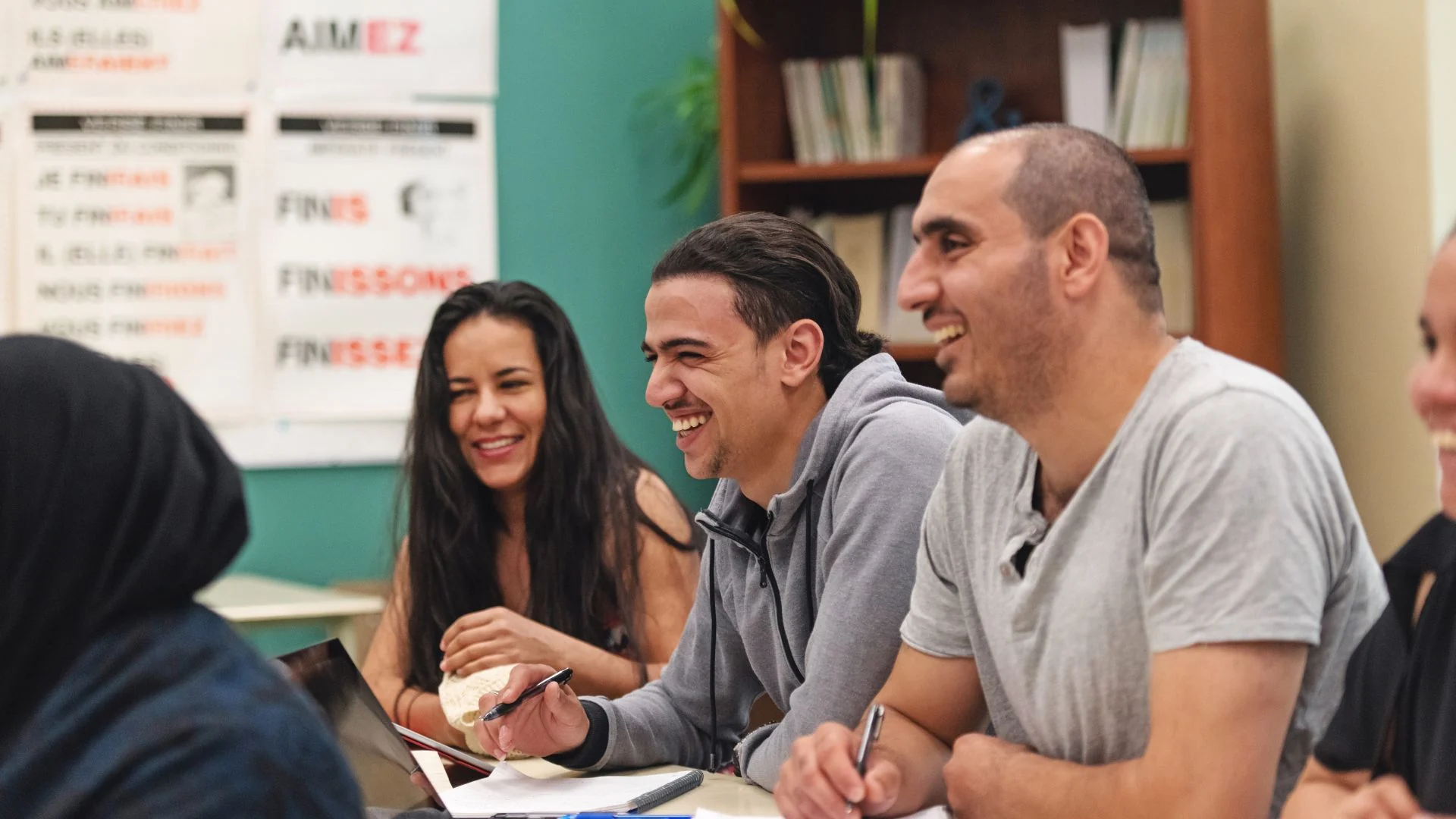

The Framework You Probably Haven't Heard Of: CEFR Proficiency Levels
The CEFR organises language ability into six levels: A1, A2, B1, B2, C1, and C2. In plain English — not the official documentation's rather baroque phrasing — the levels look like this:
- A1: Survival phrases. You can introduce yourself, order a coffee, and ask where the bathroom is.
- A2: Basic social navigation. Simple exchanges about familiar topics. Enough to get through a polite conversation without completely losing the thread.
- B1: Independent user. You can handle most situations that come up during travel or daily life, follow the main points of a meeting on a familiar topic, and express yourself on matters of personal relevance.
- B2: Confident professional use. You can hold your own in a business meeting, understand the main arguments in a complex document, and interact with native speakers without strain on either side.
- C1: Advanced. You express yourself fluently and spontaneously, and you can use language flexibly for professional and social purposes.
- C2: Near-native. Indistinguishable from a native speaker in most situations. You understand virtually everything and can express nuance with precision.
| CEFR Level | Approximate Hours from Beginner |
|---|---|
| A1 | 90–100 hours |
| A2 | 180–200 hours |
| B1 | 350–400 hours |
| B2 | 500–600 hours |
| C1 | 700–800 hours |
| C2 | 1,000–1,200 hours |
Notice the pattern: each level-to-level jump requires roughly 200 guided learning hours. "Guided" is doing important work in that sentence. Not self-directed scrolling. Not passive listening while commuting. Structured instruction in which a competent teacher is actively shaping your development, correcting your errors, and pressing you to produce language rather than merely consume it.
Most apps, to their credit, have never pretended to offer this. What they do measure — streaks, XP points, lesson completion — are proxies for engagement, not proxies for CEFR proficiency levels. The distinction matters enormously, because a learner who has maintained a 300-day streak but never had a conversation may have accumulated considerable passive recognition while making almost no progress toward the communicative ability the CEFR actually measures.
Not All Languages Are Created Equal: What the FSI Difficulty Rankings Tell You
The CEFR hour estimates above are language-neutral. They describe the journey from beginner to each level — but they do not account for the fact that French and Mandarin are not the same distance from English.
The Foreign Service Institute — which has been training US diplomats in foreign languages since 1947 — publishes difficulty rankings based on how many classroom hours a native English speaker requires to reach professional working proficiency. The results are instructive:
- Category I (French, Spanish, Italian, Portuguese): approximately 575–600 hours
- Category II (German, Indonesian, Malay): approximately 750–828 hours
- Category III (Hindi, Vietnamese, Thai, and others): approximately 900–1,012 hours
- Category IV (Mandarin, Cantonese, Japanese, Korean, Arabic): approximately 2,200 hours
The Variables That Move the Language Learning Hours Numbers
The CEFR and FSI figures are baselines, not destinies. Several factors shift the actual number of language learning hours required — some dramatically.Your Native Language, and What Else You Already Speak
As above. A Malay speaker picking up Indonesian is not starting where a monolingual English speaker starts. A Mandarin speaker learning Cantonese has covered enormous ground before the first lesson. When calculating realistic timelines, native language and existing multilingualism are the first variables to establish.
Study Intensity — Hours Per Week, Not Weeks Total
This is the variable most learners get backwards. Three hours a week for a year is 150 hours. Twenty hours a week for eight weeks is 160 hours. Those totals look similar, but the outcomes are not equivalent — retention, immersion depth, and progression all favour consistent intensity over sporadic cramming. That said, the number of guided hours accumulated is still the primary determinant of where you end up on the CEFR scale. For a busy professional, the practical implication is this: two focused, well-taught hours twice a week beats a weekend marathon once a month. Consistent, structured contact with the language — not ambitious bursts followed by long gaps — is what builds durable capability.
Your Specific Objective
There is a meaningful difference between reaching B2 general English and achieving the specific ability to conduct a supplier negotiation in Mandarin. The latter may require considerably fewer language learning hours than the raw CEFR figure suggests, if the instruction is tightly targeted at the relevant vocabulary, register, and conversational structures. As Lingua Learn Singapore puts it, a short course is entirely useful where the objective is narrow and realistic. Not every learner needs C1. Some learners need sixty hours of precisely the right sixty hours.
What You Do Between Lessons
Guided learning hours are the floor, not the ceiling. A learner who practises between sessions, listens to podcasts in the target language, or has a standing conversation with a Mandarin-speaking colleague will reach their target faster than one who opens a textbook only when the teacher is watching. Independent practice does not replace instruction; it compounds it.
Why Live Instruction Changes the Equation
An hour of structured live instruction with a native-speaking teacher is not equivalent to an hour of app-based self-study. I am not letting this point go, ever.
The mechanisms are specific and well understood. First, immediate error correction: errors that go unaddressed become habits. A native teacher hears the mistake and corrects it in real time. An algorithm logs a response and moves on. Second, spontaneous speaking practice: actually generating speech under mild conversational pressure is the process that builds fluency. Listening to recorded audio and selecting the correct translation is a different cognitive task entirely — useful, but not sufficient. Third, adaptive difficulty: a good teacher reads the learner in the room and adjusts accordingly. An algorithm adjusts to historical response data, which is a considerably blunter instrument. Fourth, accountability: a scheduled lesson with a real person creates a structural commitment that self-study almost never sustains at the same rate.
This is not a theoretical position. It reflects the standard academic consensus on communicative language teaching and the role of interaction in second language acquisition. Research on the benefits of bilingualism — cognitive, social, and professional — consistently shows that the gains come from active, engaged language use, not passive exposure.
Language class duration matters here too. Lingua Learn Singapore structures lessons in two-hour blocks, which allows for meaningful communicative activity within a single session. Thirty-minute check-ins can maintain vocabulary. They do not build the kind of sustained conversational capacity that comes from two hours of live, interactive instruction with a native speaker.
What This Looks Like in Practice: Course Formats and What They're Built For
Lingua Learn Singapore structures its private courses around CEFR-aligned learning units, with options calibrated to the learner's specific objective rather than a generic march toward fluency.
- Private 1:1 coaching is the fastest route for a learner with a defined goal — navigating a new workplace in English, or speaking Cantonese with a partner's family. Sessions are two hours; packages run from 4-hour Focused courses through to 18-hour Core modules, and longer pathways can be built from combinations of these modules.
- Small-group classes suit learners who want structured progression alongside others at a similar level. A fixed schedule creates consistent practice rhythm — the twice-weekly contact that builds language learning momentum without requiring a full-time commitment.
- Practical programmes are targeted at specific, defined situations — workplace communication, community integration, travel — rather than broad general competence. These are the in-demand courses where a narrow objective and a realistic scope produce the most efficient outcomes.
All programmes use CEFR-aligned placement assessment, so learners begin at an appropriate level rather than sitting through content they already know or being pushed into material they are not yet ready for.
“Practice isn’t the thing you do once you’re good. It’s the thing you do that makes you good.Malcolm Gladwell
A Realistic Picture: What You Can Achieve and When
Here is what the numbers look like for a professional in Singapore, stated as plainly as possible.
Starting from zero Mandarin, working two live hours per week with a native teacher and practising between sessions: realistically A1–A2 range — basic workplace phrases, simple social conversations — within six to eight months. That is roughly 50–80 guided hours, plus independent practice.
Aiming for B1 business Mandarin from scratch — the level where you can participate meaningfully in a meeting, follow most of what is said, and respond with reasonable accuracy — is a 300–400 guided hour project. At two hours per week, that is a multi-year commitment. At five hours per week with intensive practice, it compresses significantly.
A Malay speaker picking up Indonesian for regional team work could reach functional professional competence well inside 100 guided hours, given the linguistic overlap.
Language class duration — how many hours you can commit per week — is, in the end, the variable most within your control. The right language choice, the right instruction quality, and an honest objective are the other three.
The Honest Answer: What You're Actually Working Towards
"How many hours?" is a better question than "how many months?" But the best question of all is: how many hours of what, in which language, toward which specific goal, starting from where?
The anchoring data is clear enough. CEFR benchmarks suggest 200 guided hours per level. The FSI tells you which languages cost more. Your native language, study intensity, objective, and instruction quality are the multipliers that shift the final figure.
For a working professional in Singapore with a defined language goal and limited time, the smartest investment is structured, targeted, live instruction — not accumulated app streaks that do not translate into the ability to speak in a meeting or hold a conversation with someone who matters to you.
The first step is knowing your current level. Book a short placement assessment with Lingua Learn Singapore to establish your CEFR baseline, get a concrete recommendation on course type and duration, and begin with a realistic picture of what you are working toward — and how long it will actually take.